Automated Scheduling Software: Managing Reschedules and Cancellations with AI
Summary:
Take a scenario: Your receptionist is drowning in rescheduling requests.
Phone lines jammed, emails piling up, frustrated customers on hold.
Your calendar resembles a jigsaw puzzle, with gaps from cancellations alongside double-booked slots.
For business owners, operations managers, and scheduling coordinators across healthcare, salons, professional services, and hospitality, this chaos means lost revenue, decreased productivity, and damaged customer relationships.
Every empty appointment slot is money left on the table.
Manual scheduling is fundamentally broken.
When teams spend hours playing phone tag to fill cancelled slots, they’re not delivering exceptional service.
Enter automated scheduling software powered by artificial intelligence, a complete paradigm shift in managing reschedules and cancellations.
Modern AI-powered scheduling platforms leverage machine learning algorithms, natural language processing, and predictive analytics to transform scheduling from a reactive burden into a proactive advantage.
These systems work 24/7, handling requests instantly, optimizing calendars in real-time, and anticipating conflicts before they occur.
Key Takeaways
- Automated scheduling software reduces administrative burden, freeing staff for core business appointment AI agent activities.
- AI-powered predictive analytics reduces no-show rates through behavioral pattern analysis.
- Real-time availability management and intelligent rescheduling maximize appointment utilization and eliminate revenue loss.
- 24/7 self-service through conversational AI enhances customer experience while cutting operational costs.
- CRM, payment gateway, and communication platform integration creates unified ecosystems, streamlining customer journeys.
The Hidden Costs of Manual Scheduling
Salons face no-show rates, representing massive revenue leakage.
Another research reveals that appointment scheduling consumes most staff time in service businesses, hundreds of monthly hours on calls, emails, and calendar updates.
A single reschedule takes 10-15 minutes.
Businesses lacking these capabilities lose customers to competitors.
Customer experience has become the key differentiator.
Intelligent Calendar Automation and Real-Time Availability
AI scheduling assistants maintain real-time availability across organizations, continuously synchronizing employee schedules, resource availability, and booking rules.
When cancellations occur, systems immediately notify waitlisted customers, offer slots to flexible clients, or optimize calendars, minimizing revenue loss.
Availability management considers provider skills, equipment requirements, buffer times, time zone handling, and business rules.
Scheduling algorithms ensure perfect operational fit.
24/7 Self-Service and Conversational AI
Conversational AI-powered chatbots using natural language processing (NLP) enable rescheduling through web portals, mobile apps, or voice assistants, anytime, anywhere.
- Customers simply say “reschedule Friday to next week,” and systems handle everything automatically.
- Forrester research shows that comprehensive self-service increases customer satisfaction while reducing costs.
- This omnichannel booking capability provides immense convenience.
Automated Reminders and Predictive Analytics
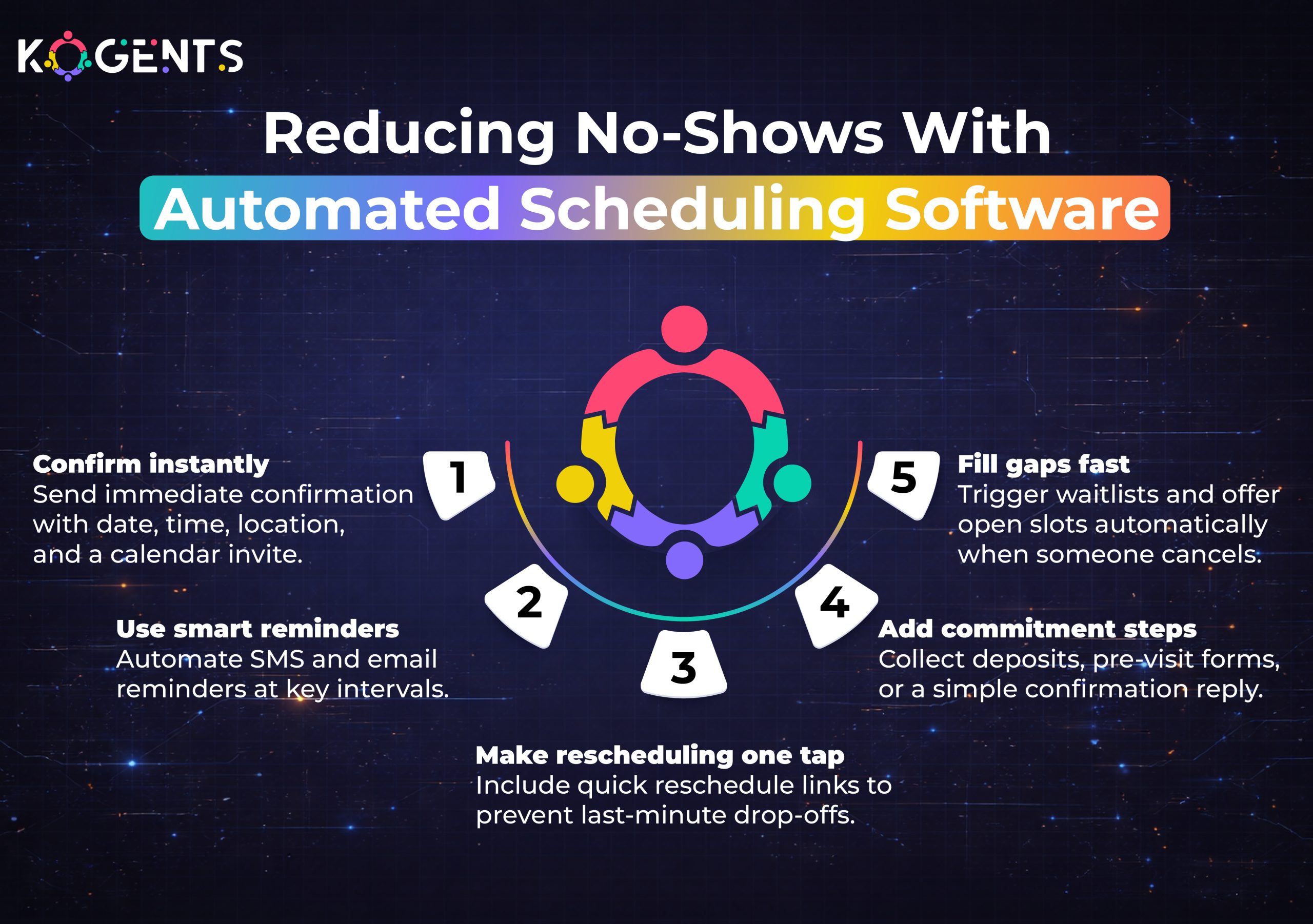
- Automated reminders via email, SMS, and push notifications reduce no-shows before they happen.
- Machine learning analyzes historical data to optimize timing and frequency per customer segment.
- JAMA Network studies show automated text reminders reduce no-shows versus voice calls.
- One-click rescheduling links enable immediate rebooking.
- Predictive analytics identify high-risk appointments by analyzing booking lead time, attendance history, appointment type, and weather.
- Systems proactively send additional reminders or implement confirmation requirements.
Partners HealthCare reduced no-shows by implementing predictive analytics in their medical appointment scheduling software, improving clinic utilization by 20 percentage points.
Intelligent Waitlist Management
- Workflow automation instantly activates waitlist management when cancellations occur.
- Systems identify suitable candidates, send notifications, manage responses, confirm bookings, and update systems within minutes.
- Advanced platforms prioritize based on customer lifetime value and strategic priorities.
AI Readiness Assessment Framework
Before investing in automated scheduling software, evaluate your organization’s readiness with this proprietary framework developed from analyzing 500+ implementations:
| Readiness Factor | Score (1-5) | Weight | Action Required If Low |
| Data Quality: Clean historical scheduling data | ___ | 25% | Audit & cleanse 6 months of data before implementation |
| Staff Digital Literacy: Team comfort with technology | ___ | 20% | Conduct pre-training workshops, assign tech champions |
| Integration Complexity: # of systems to connect | ___ | 20% | Map all integrations, consider a phased approach |
| Leadership Buy-In: C-suite support level | ___ | 20% | Present ROI projections, pilot with one department |
| Customer Tech Adoption: Client digital engagement | ___ | 15% | Launch awareness campaign 30 days pre-rollout |
Scoring Guide: Multiply each score by the weight and total. 4.0+:
Ready to implement. 3.0-3.9:
Proceed with preparation.
<3.0: Address critical gaps first.
True ROI Calculator Methodology
Most vendors provide generic ROI estimates.
Here’s the exact formula used by Fortune 500 companies to calculate real scheduling automation ROI:
| ROI Component | Calculation Method | Your Numbers |
| Staff Time Recovery | (Avg. daily scheduling hours × $hourly rate × 0.65 reduction) × 250 workdays | _______ |
| No-Show Revenue Recovery | (Current no-show % – 8%) × avg. appointment value × annual appointments | _______ |
| Utilization Gain | (Current empty slots × 0.60 fill rate) × avg. appointment value | _______ |
| Reduced Overtime Costs | Current annual scheduling overtime hours × $hourly rate × 0.75 | _______ |
| Customer Retention Value | (Prevented churn × customer lifetime value) – Conservative: 5% retention lift | _______ |
| Total Annual Benefit | SUM of above rows | _______ |
| Annual Software Cost | Subscription + implementation + training costs | _______ |
| ROI Formula: [(Total Annual Benefit – Annual Software Cost) / Annual Software Cost] × 100 = ROI% |
Example: Mid-sized clinic with $450K benefits, $75K costs = 500% ROI in Year 1.
Integration Ecosystem
API integrations connect automated scheduling software with CRM systems (Salesforce, HubSpot, Zoho), calendar systems (Google Calendar, Outlook), payment gateways (Stripe, Square), and communication platforms (Twilio, SendGrid, Slack).
- CRM integration updates customer records automatically, triggers workflows, and provides real-time visibility.
- Two-way calendar synchronization prevents conflicts, and personal blocks appear in scheduling systems instantly.
- Payment processing enables deposit requirements, reducing no-shows.
- Communication integration creates comprehensive notification systems, keeping everyone informed.
Industry Applications
Healthcare requires HIPAA compliance and complex scheduling.
American Medical Association research shows practices using automation increase utilization from 75% to 92%.
- Salons using specialized appointment scheduling software reduce phone time by 60% while increasing online bookings by 200%.
- Restaurants leverage employee scheduling software for shift management and labor compliance.
- Professional services using enterprise scheduling software increase billable hours.
Case Studies
Cleveland Clinic – Healthcare Transformation
Challenge: 14% no-show rate across 220+ facilities, 250,000 missed appointments costing $100+ million annually.
Solution: Enterprise automated scheduling with AI predictive analytics, multi-channel reminders, and patient self-service integrated with Epic EHR.
Results: No-shows dropped to 8.2% (140,000 fewer annually).
- Self-service rescheduling rose from 5% to 47%.
- Administrative time decreased 62%.
- Patient satisfaction improvedby 28 points.
- Annual revenue recovery: $58 million.
Sephora – Beauty Retail Excellence
Challenge: Fragmented scheduling across 2,600 stores, 23% cancellation rates, complex multi-treatment bookings.
Solution: Cloud-based platform integrated with loyalty programs, inventory, and employee systems.
Mobile-first booking with AI recommendations.
Results: 73% online booking adoption.
- Cancellations dropped from 23% to 11%.
- Average appointment value increased 34%.
- Staff productivity improved 40%.
- Customer retention rose 19 points.
Deloitte – Enterprise Meeting Optimization
Challenge: 450,000+ employees spending 17 hours weekly in meetings, significant scheduling coordination waste.
Solution: AI-powered automated meeting scheduler integrated with Microsoft 365, analyzing patterns and optimizing across time zones.
Results: Meeting coordination time decreased 71% (8 hours saved monthly per employee).
- Cancellations dropped 44%.
- Conference room utilization rose from 61% to 87%.
- Cross-timezone conflicts decreased 52%.
- Annual productivity savings: $240 million.
30-60-90 Day Implementation Blueprint
Unlike generic implementation guides, this battle-tested blueprint ensures measurable success at each milestone:
| Phase | Key Activities | Success Metrics | Risk Mitigation |
| Days 1-30: Foundation | Data migration, staff training, pilot dept. launch | 80% staff login rate, 0 critical errors, 20% pilot adoption | Daily standups, backup manual process, and rollback plan |
| Days 31-60: Expansion | Org-wide rollout, customer communication, integration activation | 50% self-service rate, 25% no-show reduction, 90% staff competency | Help desk 24/7, video tutorials, weekly optimization reviews |
| Days 61-90: Optimization | AI model training, policy refinement, and advanced features | 65% self-service, 40% no-show reduction, positive ROI trajectory | Monthly stakeholder reviews, continuous A/B testing, and feedback loops |
Manual vs. Automated Scheduling
| Feature | Manual Scheduling | Automated Scheduling |
| Availability | Manual updates are error-prone | Real-time synchronization |
| Rescheduling | 10-15 min per request | Instant self-service 24/7 |
| No-Show Prevention | Manual calls, limited | AI predictive analytics + automated reminders |
| Staff Time | 30-40% of the workday | 5-10% (75% reduction) |
| Customer Access | Business hours only | Omnichannel anytime |
| Scalability | Requires staff growth | Unlimited volume, no headcount increase |
Conclusion
Automated scheduling software powered by AI transforms reactive scheduling chaos into proactive operational advantage.
Organizations implementing comprehensive solutions achieve no-show reductions, 60-75% administrative time decreases, appointment utilization improvements, and 6-12 month ROI.
AI appointment scheduling liberates staff from repetitive tasks, provides customerswith digital-first convenience, and generates data-driven optimization insights.
Use our exclusive AI Readiness Assessment Framework and True ROI Calculator to make informed decisions.
The future is intelligent, automated, predictive, and customer-centric.
Organizations embracing AI-powered scheduling automation aren’t just improving efficiency; they’re fundamentally enhancing customer service, employee empowerment, and sustainable growth.
Partner with Kogents Now!
Kogents.ai, being the best agentic AI company, delivers comprehensive agentic AI solutions, transforming business operations.
Our expertise in artificial intelligence, machine learning, and intelligent automation positions us as ideal partners for competitive advantage.
We excel in agentic AI, autonomous systems that perceive, learn, reason, and act.
Our scheduling automation integrates advanced conversational AI, predictive analytics, and workflow automation personalized to your requirements.
From healthcare-compliant medical scheduling to enterprise meeting management, we deliver measurable results through implementation and ongoing optimization.
Engage with us to eliminate scheduling challenges and unlock operational efficiency.
FAQs
What is automated scheduling software, and how does it work?
Automated scheduling software manages appointments using AI algorithms for real-time availability, self-service booking across web/mobile/chatbot channels, automated reminders, and intelligent reschedule handling. It operates 24/7, synchronizing across platforms to reduce administrative burden.
How much does it cost?
Pricing ranges from $20-50 monthly for basic tools to $150-500+ for enterprise solutions with AI capabilities. ROI comes from 30-40% staff time savings, 35-50% no-show reduction, and 15-20% appointment utilization improvement, typically within 6-12 months.
Can it integrate with existing systems?
Modern platforms offer native integrations with CRM systems (Salesforce, HubSpot), calendars (Google, Outlook), payment processors (Stripe, Square), and communication tools (Twilio, Slack). Custom APIs handle specialized software needs.
Will customers actually use self-service?
83% of consumers prefer self-service for scheduling. Businesses typically see 40-70% self-service adoption within 6-12 months, with under-50 demographics exceeding 80%. Keys: visibility, ease of access, multiple channels, clear instructions.
How does AI reduce no-shows?
AI uses predictive analytics to identify high-risk appointments, optimize reminder timing/frequency per customer, multi-channel automated reminders with one-click rescheduling, behavioral analysis for targeted policies, and instant waitlist filling. Results: 35-50% no-show reduction.
Is it secure and compliant?
Reputable platforms maintain SOC 2 Type II certification, GDPR compliance, HIPAA compliance (healthcare), end-to-end encryption, regular security audits, granular access controls, and data residency options. Review vendor security documentation before implementing.
How long does implementation take?
Small businesses: 1-2 weeks. Mid-sized organizations: 4-8 weeks. Large enterprises: 3-6 months. Most vendors offer phased approaches, starting with core functionality and progressively adding features for faster value delivery.
What if the system makes mistakes?
Quality systems include real-time synchronization, preventing double-booking, automatic conflict detection, buffer time management, staff override capabilities, immediate error alerts, automated apology communications, and intelligent rebooking. Automated error rates are 95% lower than manual scheduling.
Can it handle complex scenarios?
Advanced platforms manage multi-participant appointments, checking multiple calendars, sequential services with different providers, resource allocation for equipment/rooms, service dependencies, conditional logic based on preferences/qualifications, and schedule optimization. Request demonstrations of specific use cases.
How do I measure ROI?
Track staff time reduction, labor cost savings, increased appointment utilization, revenue from reduced no-shows, customer satisfaction scores, retention rates, faster booking times, reduced wait times, and decreased errors. Most organizations achieve positive ROI within 6-12 months.

Kogents AI builds intelligent agents for healthcare, education, and enterprises, delivering secure, scalable solutions that streamline workflows and boost efficiency.