Stop Losing Clients: Instant Booking Responses = More Sales.
Summary:
A potential client visits your website at 9 PM, ready to book. They submit your contact form and wait.
Your office is closed.
Ten minutes later, they chose a competitor that confirmed the appointment instantly.
You lose the sale without ever knowing the lead existed.
This happens every day.
Research shows that responding to leads within five minutes dramatically increases conversion rates, yet many businesses still rely on manual booking and delayed follow-ups.
In legal, healthcare, consulting, and service-based industries, even small response delays translate directly into lost revenue.
Today’s customers expect immediate confirmation.
When they do not get it, they move on.
The solution is not longer hours or more staff.
It is automated booking systems that respond instantly, capture demand after hours, and convert prospects without human intervention.
Automation is no longer just convenient. It is essential for competing, converting, and growing in a market where speed defines success.
Key Takeaways
- Businesses responding to inquiries within 5 minutes are 100x more likely to convert leads than those waiting for more than half an hour.
- 62% of customers expect businesses to be available outside traditional working hours for scheduling.
- Automated systems reduce double-bookings and scheduling conflicts by up to 95%.
- 73% of service appointments are now researched or booked via mobile devices.
- Connected booking systems syncing with CRM and calendar platforms increase operational efficiency.
The Revenue Crisis of Slow Response Times
The Cost of Delayed Responses
Every business operates with an invisible timer ticking against potential revenue.
Research reveals that lead response time directly correlates with conversion probability.
Their comprehensive analysis found:
- Responding within 1 minute increases conversion likelihood by 391%
- After 5 minutes, the conversion probability drops by 80%
- After 10 minutes, you’re 400% less likely to qualify the lead
These aren’t marginal differences; they’re business-defining statistics that separate thriving companies from struggling ones.
The Modern Customer’s Expectations
Today’s consumers have been conditioned by companies like Amazon, Uber, and Netflix to expect instantaneous service.
This expectation extends directly to the booking process.
When potential clients reach out to ai booking assistant to schedule services, they’re not just requesting an appointment; they’re evaluating your entire business operations and organizational efficiency.
A delayed response signals:
- Lack of operational excellence
- Poor resource management
- Limited commitment to customer service
- Outdated business processes
Competitive Disadvantage in Real-Time
Your competitors aren’t waiting.
In service industries where differentiation is minimal, response speed becomes the deciding factor.
Consider the legal services sector: When someone needs an attorney, they’re often stressed, urgent, and willing to pay premium rates.
They’ll contact multiple firms.
The firm that confirms availability first, even if their rates are higher, typically wins the business simply because they eliminated the prospect’s anxiety fastest.
Understanding Automated Booking Systems
An automated booking system is a software solution that enables customers to schedule appointments, reserve services, or book resources without human intervention.
These platforms leverage artificial intelligence, machine learning, and workflow automation to manage the entire scheduling lifecycle:
- Real-time availability checking across multiple calendars
- Instant confirmation emails and SMS notifications
- Payment processing and deposit collection
- Automatic reminder sequences to reduce no-shows
- CRM integration for seamless data synchronization
- Analytics dashboards for performance tracking
Core Components of Effective Systems
Intelligent Scheduling Engine: Uses algorithmic analysis to optimize appointment slots based on service duration, staff availability, resource allocation, and historical booking patterns.
Multi-Channel Integration: Accepts bookings from websites, social media platforms, Google Business listings, and mobile applications, creating a unified customer journey.
Smart Communication: Deploys natural language processing to understand customer inquiries and deliver contextually appropriate responses through chatbots and automated messaging.
Dynamic Availability Management: Synchronizes with team calendars (Google Calendar, Outlook, Apple Calendar) to prevent double-bookings and maintain accuracy.
Technology Stack Behind Modern Systems
Leading automated booking platforms employ sophisticated technology infrastructure:
- Cloud computing for scalability and reliability
- API frameworks for third-party integrations
- Encryption protocols (ISO/IEC 27001, SOC 2 compliance) for data security
- Machine learning algorithms for predictive scheduling and demand forecasting
- Mobile-responsive design ensuring seamless experiences across devices
The Psychology Behind Instant Gratification
Neurological Drivers of Immediate Response
Human brains are wired for immediate rewards.
Neuroscience research published in the Neuron journal demonstrates that the brain’s reward circuitry activates more intensely for immediate gains than delayed benefits, even when delayed options are objectively superior.
When a potential client receives instant booking confirmation, their brain releases dopamine, the same neurotransmitter associated with pleasure and satisfaction.
This neurological response creates:
- Positive brand association
- Reduced decision anxiety
- Increased trust signals
- Higher customer loyalty from the first interaction
The Paradox of Choice and Decision Fatigue
Psychologist Barry Schwartz’s research on the paradox of choice reveals that excessive options and delayed decisions create stress and dissatisfaction.
When customers must wait for scheduling confirmation, they experience:
- Continued mental processing of the decision
- Opportunity for second-guessing
- Openness to competitive alternatives
- Increased likelihood of abandonment
Automated booking systems eliminate this friction by providing immediate closure, allowing customers to mentally commit and move forward.
Building Trust Through Consistency
- Behavioral economics demonstrates that consistency and reliability drive trust more effectively than sporadic excellence.
- An automated system that delivers instant confirmations 24/7 builds stronger customer relationships than a highly personalized but inconsistent manual process.
Key Features of High-Converting Booking Systems
Real-Time Availability Display
- Transparency drives AI chatbots for lead generation.
- Systems that show actual availability, rather than requiring back-and-forth communication, convert at dramatically higher rates.
Intelligent Routing and Resource Allocation
Advanced systems use predictive analytics to:
- Match clients with appropriate service providers based on expertise
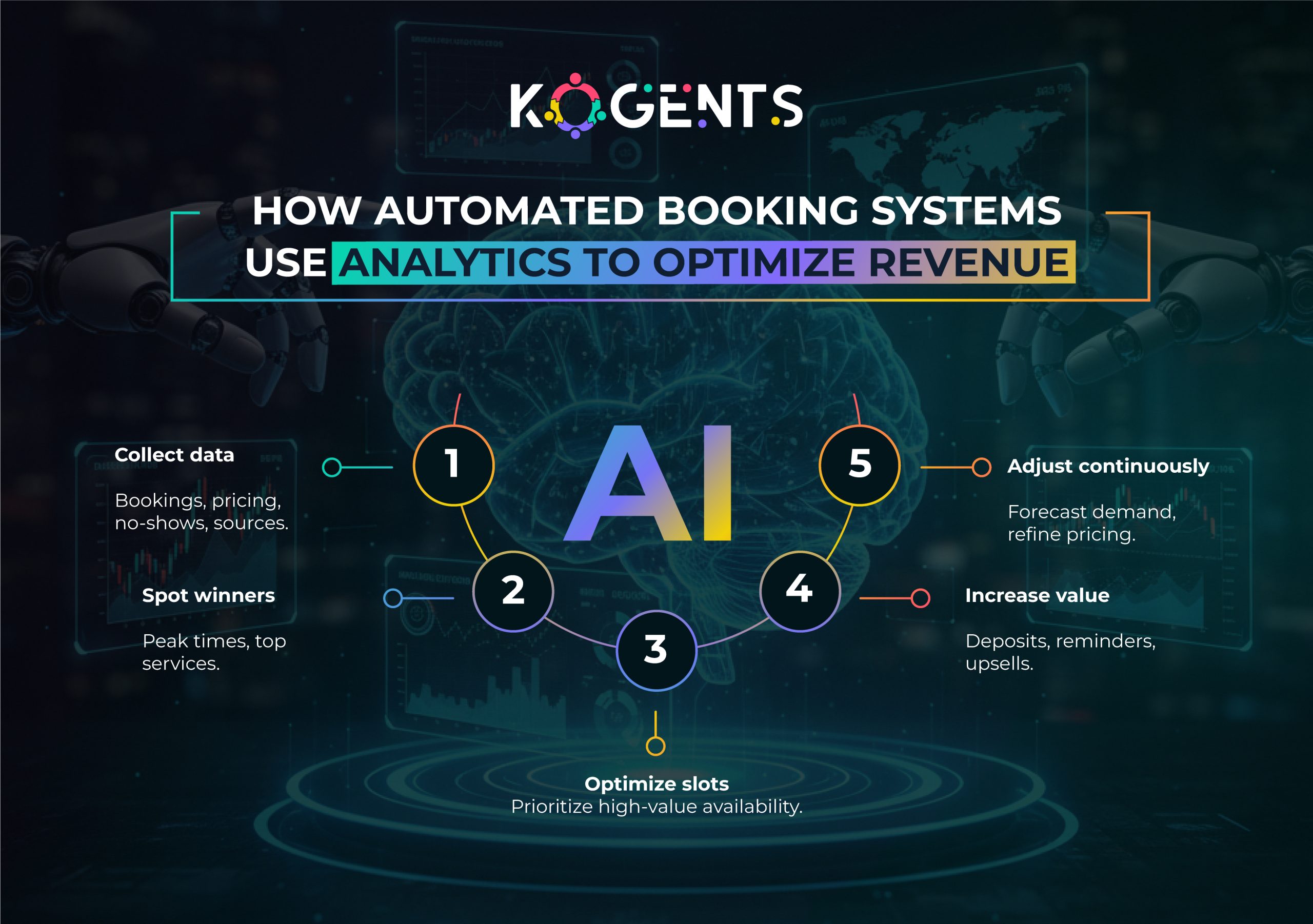
- Optimize slot allocation for maximum revenue
- Balance workload across team members
- Prioritize high-value bookings during peak times
Payment Integration and Revenue Optimization
Friction-free payment processing is critical.
Systems integrating Stripe, Square, PayPal, or similar platforms that collect deposits or full payment during booking see:
- 40% reduction in no-shows
- Higher perceived commitment from customers
- Improved cash flow management
- Reduced administrative burden
Smart Reminder Systems
- 29% reduction in missed appointments
- 38% increase in on-time arrivals
- Better customer retention through engagement
Mobile-First Design
- One-tap calendar integration
- Minimal form fields (autofill capability)
- Large, thumb-friendly buttons
- Progressive disclosure of information
- Accelerated mobile pages (AMP) for faster loading
Industry-Specific Applications and Case Studies
Healthcare: Cleveland Clinic’s Digital Transformation
Cleveland Clinic, one of America’s premier healthcare institutions, implemented an enterprise-level automated booking system in 2019, enabling patients to schedule appointments online 24/7.
Results:
- 35% increase in new patient appointments within the first year
- 60% reduction in phone call volume to scheduling centers
- 92% patient satisfaction rating for online booking experience
- $2.8 million annual savings in administrative costs
The system is integrated with their electronic health records (EHR), enabling seamless data synchronization and eliminating duplicate data entry, a common pain point in healthcare workflow automation.
Legal Services: LegalZoom’s Client Acquisition Engine
LegalZoom transformed legal services accessibility through automated consultation booking. Their platform allows potential clients to:
- Select specific legal services from a categorized menu
- View attorney availability in real-time
- Book 30-minute consultations instantly
- Complete intake forms automatically synced to attorney dashboards
Impact:
- 250% increase in consultation bookings year-over-year
- 45-second average booking completion time
- 68% conversion rate from consultation to retained services
- Expanded addressable market to clients outside traditional 9-5 availability
Measuring Success: Metrics That Matter
Primary Conversion Metrics
| Metric | Definition | Target Benchmark |
| Response Time | Average time from inquiry to confirmation | < 5 minutes (ideally instant) |
| Booking Conversion Rate | % of visitors who complete booking | 15-25% (industry dependent) |
| Abandonment Rate | % who start but don’t complete booking | < 20% |
| No-Show Rate | % of confirmed appointments not attended | < 10% |
| Revenue Per Appointment | Average transaction value | Trending upward quarterly |
| Customer Lifetime Value | Total revenue from repeat bookings | Increase of 20%+ annually |
Operational Efficiency Indicators
Time Savings: Calculate hours recovered from eliminated phone tag, manual calendar management, and confirmation follow-ups.
Leading implementations show a 30-40% reduction in administrative time.
Staff Utilization: Measure how automation allows team members to focus on high-value activities rather than scheduling logistics.
Track reallocation of hours to customer service, sales, or service delivery.
System Uptime: Monitor platform reliability, aim for 99.9% uptime to maintain customer trust.
Customer Experience Metrics
Net Promoter Score (NPS): Survey customers post-booking: “How likely are you to recommend our booking process?” Target: 50+ (excellent).
Customer Effort Score (CES): “How easy was it to book your appointment?” Lower effort correlates with higher retention.
Review Sentiment Analysis: Track mentions of “easy booking,” “convenient,” and “instant confirmation” in online reviews using sentiment analysis tools.
Partner with Kogents for AI-Powered Booking Excellence!
Businesses that embrace automated booking systems don’t just save time; they fundamentally transform their customer acquisition process into a 24/7 revenue-generating machine.
Kogents.ai stands at the forefront of agentic AI innovation, delivering intelligent automation solutions that go beyond simple scheduling.
Our AI agents don’t just book appointments; they understand context, anticipate customer needs, and optimize every interaction for maximum conversion.
Whether you’re a legal practice seeking to capture after-hours consultations, a healthcare provider reducing administrative burden, or a professional services firm maximizing billable hours, Kogents delivers AI-powered automation that drives measurable results.
Partner with us to transform your booking process from a cost center into your most powerful sales tool.
FAQs
What is an automated booking system, and how does it increase sales?
An automated booking system is a software platform that enables customers to schedule appointments, reserve services, or book consultations without human intervention, operating 24/7. It increases sales by eliminating response delays—research shows businesses responding within 5 minutes are 100x more likely to convert leads than those waiting 30+ minutes. The system captures prospects during their peak buying intent, reduces abandonment through friction-free scheduling, and converts inquiries into confirmed bookings instantly, even outside business hours, when 62% of customers prefer to schedule appointments.
How much does implementing an automated booking system typically cost?
Implementation costs vary significantly based on business size, customization requirements, and platform selection. Small businesses using SaaS solutions like Calendly or Acuity can start at $8-$15/month per user. Mid-sized businesses requiring CRM integration and advanced features typically invest $50-$200/month. Enterprise solutions with custom development, API integrations, and dedicated support range from $500-$5,000/month. However, ROI analysis consistently shows 300-500% returns within 12 months through increased conversions, reduced no-shows, and administrative time savings worth $2,000-$10,000 monthly for typical service businesses.
Will automated booking systems work for businesses requiring consultative sales processes?
Absolutely. Modern intelligent booking platforms excel at qualifying prospects through smart intake forms, conditional logic, and AI-powered chatbots that gather necessary information before scheduling. For consultative services, systems can route leads to appropriate specialists, trigger automated follow-up sequences, and integrate with CRM platforms to track the entire sales cycle. Legal firms, financial advisors, and B2B consultants using automated qualification + booking see 40-60% increases in qualified consultation bookings while reducing unqualified tire-kickers by 70%.
How do automated systems reduce no-shows compared to manual booking?
Automated systems combat no-shows through multiple mechanisms: (1) Payment integration collecting deposits during booking increases commitment—research shows 40% reduction in no-shows when payment is required; (2) Automated reminder sequences via email and SMS at strategic intervals (72 hours, 24 hours, 2 hours before) reduce no-shows by 29%; (3) Easy rescheduling options reduce last-minute cancellations; (4) Calendar integration prevents scheduling conflicts that cause cancellations. Combined, these features typically reduce no-show rates from 20-30% to below 10%, dramatically improving revenue reliability.
Can automated booking systems integrate with existing CRM and calendar platforms?
Yes, leading automated booking platforms offer extensive integration capabilities with popular business software. Most connect seamlessly with Google Calendar, Outlook, Apple Calendar, Salesforce, HubSpot, Zoho, Microsoft Dynamics, Mailchimp, and hundreds of other platforms via native integrations or API connections. Advanced systems use middleware like Zapier to bridge disparate systems. When evaluating platforms, verify integration compatibility with your existing technology stack—this ensures data synchronization, eliminates duplicate entry, and maintains a single source of truth across your business operations. Enterprise implementations often include custom integration development for proprietary systems.
What security measures protect customer data in automated booking systems?
Reputable automated booking platforms implement multiple security layers: end-to-end encryption for data transmission, AES-256 encryption for data storage, SOC 2 Type II certification validating security controls, ISO 27001 compliance for information security management, PCI DSS compliance for payment processing, GDPR compliance for European data protection, regular third-party security audits, two-factor authentication for administrative access, role-based access controls limiting data visibility, automatic security updates and patches, and comprehensive audit logs. Healthcare providers should ensure HIPAA compliance with Business Associate Agreements (BAAs). Always review security documentation and request penetration test results before implementation.
How do automated booking systems handle complex scheduling scenarios like multi-provider coordination?
Advanced automated booking systems excel at complex scheduling through algorithmic optimization. They manage multi-provider scenarios by synchronizing availability across team calendars in real-time, implementing intelligent routing based on expertise, service type, or customer preferences, balancing workload distribution to prevent burnout or underutilization, accommodating buffer times between appointments for preparation or travel, handling resource dependencies (rooms, equipment) alongside provider availability, and supporting team-based appointments requiring multiple providers simultaneously. Machine learning algorithms analyze historical patterns to optimize slot allocation for maximum revenue and customer satisfaction.
What happens if the automated booking system experiences downtime or technical issues?
Reliable platforms maintain 99.9% uptime through redundant infrastructure, load balancing, and cloud computing architecture distributed across multiple data centers. When outages occur, best practices include: maintaining a backup manual booking process (phone, email) with clear staff protocols, implementing status page monitoring, notifying customers of technical issues, ensuringthe system stores incomplete bookings for recovery when service is restored, using offline-capable mobile apps that sync when connectivity returns, and having customer support immediately accessible during outages. Choose vendors offering SLAs (Service Level Agreements) with guaranteed uptime commitments and financial penalties for excessive downtime. Test disaster recovery procedures during implementation to ensure business continuity.

Kogents AI builds intelligent agents for healthcare, education, and enterprises, delivering secure, scalable solutions that streamline workflows and boost efficiency.