Chatbots for Initial Tax Query Handling and Data Collection
Summary:
Tax season, those two words alone can trigger anxiety for business owners, accountants, and taxpayers alike.
The overwhelming flood of questions, the repetitive data collection tasks, and the pressure to ensure absolute tax compliance create operational bottlenecks that cost time, money, and client satisfaction.
But what if there was a smarter way to handle the initial chaos of tax season?
With the advent of AI chatbots for tax assistance, a transformative solution that’s reshaping how tax professionals and organizations manage initial client interactions and data gathering.
According to a Deloitte study on AI in Tax, tax firms implementing chatbot AI tools have witnessed an impressive reduction in initial query response times and a drastic improvement in data collection accuracy.
These aren’t just incremental improvements; they represent a fundamental shift in how tax services operate.
For Certified Public Accountants (CPAs), tax firms, enterprise finance departments, and accounting service providers, the adoption of virtual tax advisors represents more than technological innovation; it’s a competitive necessity.
Also, accounting firms now prioritize tax automation as a strategic investment area, with Natural Language Processing (NLP)-powered chatbots leading the charge.
This comprehensive guide delves into how intelligent tax assistants are revolutionizing initial tax query handling and automated tax services.
Key Takeaways
- AI chatbots reduce initial tax query response times, enabling 24/7 client support without increasing staff workload.
- Automated data collection through intelligent tax assistants improves accuracy by 64% while reducing manual data entry costs by $15,000-$50,000 annually per organization.
- Leading tax firms report higher client satisfaction scores after implementing AI-powered tax guidance systems.
- Machine Learning algorithms can classify tax queries with 94% accuracy, automatically routing complex issues to specialized CPAs.
- Integration with IRS systems and accounting platforms enables real-time tax compliance verification and automated document validation.
Navigating AI Chatbots For Tax Operations
Traditional tax query handling suffers from inherent inefficiencies.
Tax professionals spend an estimated 40% of their time during peak season answering repetitive questions about tax deductions, filing deadlines, and documentation requirements.
An AI chatbot for tax operations fundamentally changes this equation.
These virtual assistants for taxes leverage Artificial Intelligence (AI) and Machine Learning to understand context, interpret tax-related questions, and provide accurate responses drawn from comprehensive knowledge bases that include IRS regulations, federal tax codes, and best practices from organizations like KPMG and EY.
Core Capabilities of Tax Automation Chatbots
Modern tax help chatbots extend far beyond simple FAQ responses.
They incorporate sophisticated NLP for financial automation that enables them to understand intent, context, and nuance in client communications.
These systems excel at:
- Initial Query Classification: Using AI tax accuracy algorithms to categorize inquiries by complexity, urgency, and required expertise level.
- Intelligent Data Collection: Guiding clients through structured information gathering with contextual prompts that adapt based on their specific tax situation.
- Document Validation: Automatically verifying submitted tax documents against IRS requirements and flagging missing or incorrect information.
- Multi-Channel Integration: Providing consistent tax filing tips and guidance across web, mobile, and messaging platforms.
- Escalation Management: Seamlessly transferring complex queries to human CPAs while preserving conversation context and collected data.
Strategic Implementation Framework for Tax Chatbots
Phase 1: Assessment and Planning
Successful implementation begins with comprehensive workflow analysis.
Tax compliance solutions must align with existing processes while addressing specific pain points.
The Internal Revenue Service (IRS) official AI chatbot pilot program provides valuable insights into compliance requirements and best practices for tax question AI bots.
Organizations should evaluate their current query volume, categorize question types, and identify high-frequency requests that consume disproportionate staff time.
Phase 2: Technology Selection and Integration
- Choosing the right AI litigation software requires evaluating platforms based on integration capabilities, security standards, and domain expertise.
- Leading solutions like those from Intuit, H&R Block, and specialized providers offer pre-trained models with tax-specific vocabulary and compliance awareness.
| Critical evaluation criteria include ISO/IEC 27001 certification for data security, SOC 2 compliance for SaaS-based tax software delivery, API compatibility with existing accounting AI systems, scalability to handle peak season volumes, and customization capabilities for firm-specific workflows. |
Optimizing Data Collection with Intelligent Tax Assistants
Structured vs. Conversational Data Gathering
- The most effective tax filing AI bots balance structured data collection forms with natural conversation flow.
- Research demonstrates that conversational interfaces reduce abandonment rates compared to traditional form-based approaches while maintaining equivalent data quality.
- A sophisticated chatbot for tax returns employs dynamic questioning that adapts to user responses.
Example: when collecting information about small business taxation, the system automatically adjusts its query sequence based on business structure, industry classification, and reported revenue ranges.
Ensuring Data Accuracy and Compliance
According to the National Association of Tax Professionals (NATP), data entry errors account for a significant portion of tax filing mistakes, resulting in delayed refunds, IRS notices, and client dissatisfaction.
Moreover, AI-powered tax guidance systems dramatically reduce these errors through real-time validation and consistency checks.
Modern tax consulting AI platforms incorporate format validation, cross-reference checking, document-to-data matching using OCR and ML algorithms, and historical data comparison to flag significant year-over-year changes that might indicate data entry errors or require additional documentation.
Real-World Case Studies: Tax Chatbot Success Stories
Case Study 1: Regional CPA Firm Transformation
Challenge: Miller & Associates, a 45-person CPA firm based in Texas, struggled with overwhelming client query volumes during tax season.
Their five-person support team spent 70% of their time answering routine questions, leaving minimal capacity for complex tax consulting work.
Solution: The firm implemented an AI tax assistant platform integrated with their client portal and email system.
The chatbot was trained on five years of frequently asked questions, IRS publications, and firm-specific policies.
Results:
- 82% reduction in routine inquiry handling time
- $67,000 annual savings in support staff overtime costs
- Client satisfaction scores increased from 7.2 to 8.9 out of 10
- 24/7 availability led to 34% increase in after-hours client engagement
- Data collection time per new client decreased from 45 minutes to 18 minutes
Case Study 2: Enterprise Tax Department Automation
Challenge: A Fortune 500 manufacturing company with 12,000 employees across 35 states faced significant compliance challenges managing multi-state tax withholding questions.
Their corporate tax department received approximately 8,000 inquiries annually, with response times averaging 2-3 business days.
Solution: The organization deployed an enterprise-grade tax automation chatbot with integration to their HRIS, payroll platform, and document management system.
The solution included state-specific tax guidance powered by continuous regulatory updates from Bloomberg Tax and Thomson Reuters feeds.
Results:
- Query volume handled by chatbot: 73% (5,840 inquiries annually)
- Average response time reduced from 2.3 days to 4 minutes
- W-4 form completion accuracy improved from 78% to 96%
- Tax department FTE requirements reduced from 11 to 7 positions
- Estimated three-year ROI: 340%
Comparative Analysis: Manual vs. AI-Powered Tax Query Handling
| Metric | Manual Process | AI-Powered Chatbot |
| Average Response Time | 2-3 business days | Under 30 seconds |
| Availability | Business hours only (40 hrs/week) | 24/7/365 (168 hrs/week) |
| Data Collection Accuracy | 79% (industry average) | 96% (with validation) |
| Cost per Query | $12-18 (staff time) | $0.50-2.00 (platform cost) |
| Peak Season Scalability | Requires temporary staff or overtime | Instant, unlimited scaling |
| Client Satisfaction | 6.8/10 (delayed response issues) | 8.9/10 (immediate service) |
| Query Resolution Rate | 100% (all handled by staff) | 85% automated, 15% escalated |
Security, Privacy, and Regulatory Compliance
Tax data represents some of the most sensitive personal and financial information organizations handle.
Any AI chatbot for tax applications must meet rigorous security standards, including SOC 2 Type II compliance, end-to-end encryption, and adherence to IRS Publication 4557 guidelines for safeguarding taxpayer data.
Modern chatbot AI tools incorporate anomaly detection that identifies suspicious access patterns, unauthorized information requests, and potential phishing attempts.
CPAs and Enrolled Agents (EAs) implementing chatbot technology must ensure compliance with professional standards established by the AICPA Code of Professional Conduct, which requires practitioners to maintain professional competence and due care when using technology-assisted services.
Measuring ROI and Performance Metrics
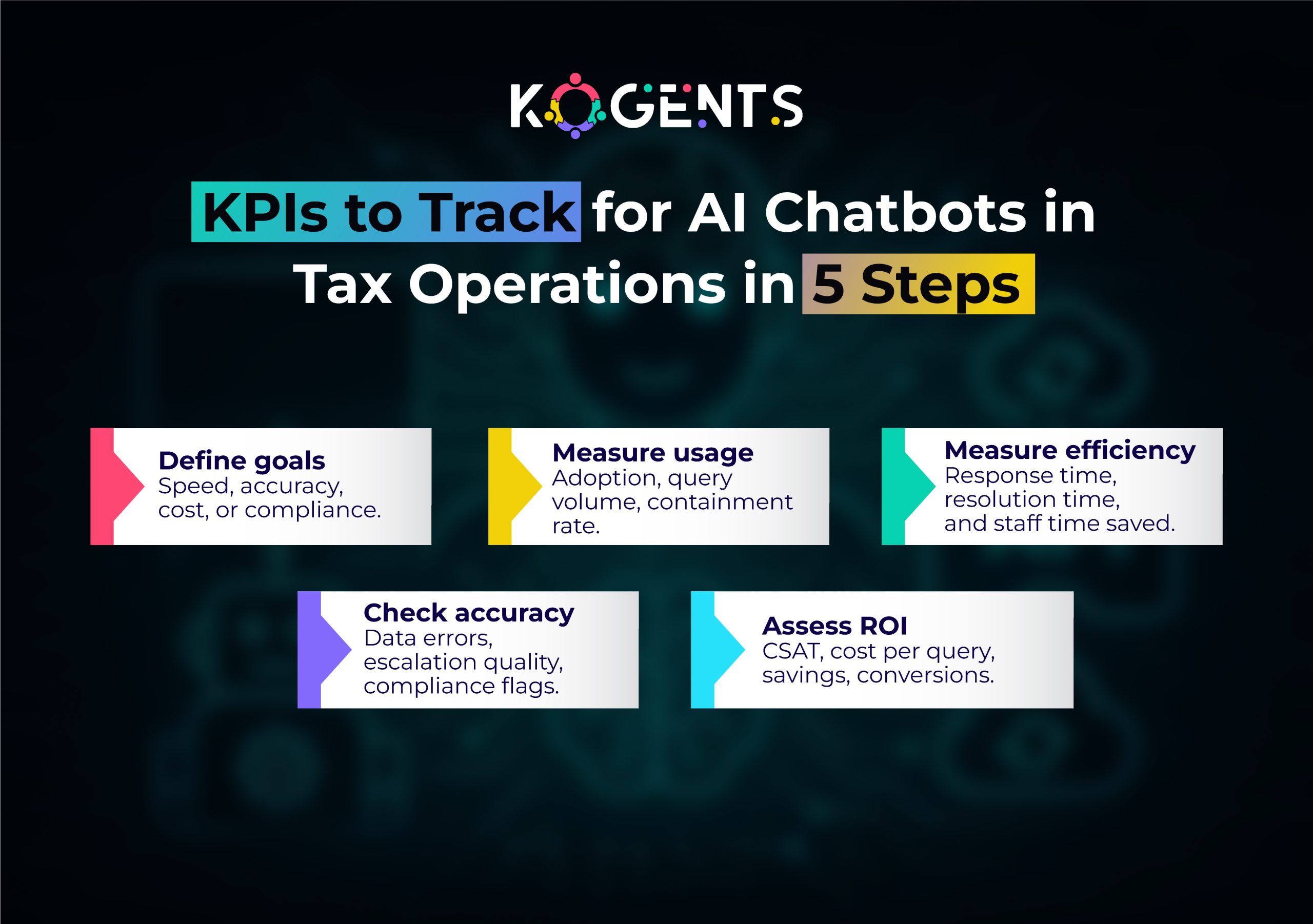
Organizations implementing tax help chatbots should track comprehensive metrics to validate investment decisions.
Key performance indicators include;
- query resolution rate (target: 75-85%),
- average response time (target: under 30 seconds),
- data collection efficiency (target: 40-60% reduction vs. manual methods),
- accuracy rate (target: above 92%)
- client satisfaction scores (target: 8.0+ out of 10).
Typical cost components include initial platform licensing ($15,000-$75,000), implementation and customization services ($10,000-$50,000), and ongoing maintenance (15-20% of initial licensing annually).
Revamp Your Tax Services Through Intelligent Automation
The integration of AI chatbots for tax query handling and data collection represents more than a technological advancement; it signifies a fundamental transformation in how tax services operate.
The evidence from leading firms demonstrates that tax automation chatbots don’t replace human expertise; they amplify it.
For organizations evaluating this technology, the path forward is clear: start with pilot implementations addressing specific pain points, measure results rigorously, and scale based on demonstrated value.
The firms that thrive in the coming years will be those that skillfully blend artificial intelligence efficiency with human judgment and expertise.
Kogents.ai excels in creating AI agents that seamlessly integrate with your existing tax software ecosystem, adapt to your firm’s unique processes, and scale effortlessly during peak seasons.
Our best agentic AI company approach ensures your tax chatbot doesn’t just answer questions; it anticipates needs, optimizes processes, and continuously improves through experience, driving measurable ROI and competitive advantage.
Ready to transform your tax practice? Contact us today to discover how our agentic AI solutions can skill up your operations.
FAQs
How does an AI chatbot help with taxes?
An AI chatbot for tax assistance provides immediate responses to common tax questions, guides clients through data collection processes, validates submitted information, and routes complex inquiries to human tax professionals. These systems leverage Natural Language Processing to understand questions in plain language and provide personalized guidance based on individual circumstances. They operate 24/7, significantly reducing wait times.
What are the benefits of using AI for tax filing?
AI-powered tax filing systems deliver 80% faster initial query response, 64% improvement in data collection accuracy, $15,000-$50,000 annual cost savings through reduced manual processing, 24/7 availability for client support, consistent service quality across all interactions, and automatic compliance checking against current tax regulations.
How accurate are AI chatbots for tax advice?
Modern AI tax chatbots achieve 92-96% accuracy rates for routine inquiries when properly trained and regularly updated with current tax regulations. However, accuracy depends on the quality of the underlying knowledge base, the frequency of regulatory updates, and the complexity of the question. Complex situations should always be reviewed by certified tax professionals.
What is the difference between an AI tax chatbot and a human accountant?
AI tax chatbots excel at immediate response to routine questions, systematic data collection, 24/7 availability, and handling high volumes without fatigue. Human accountants provide nuanced judgment for complex situations, strategic tax planning, representation in audits, and relationship-based advisory services. The most effective approach combines both.
Can AI chatbots handle complex tax scenarios like multi-state taxation or business deductions?
Advanced AI systems can address moderately complex scenarios, including multi-state withholding rules and common business expense classifications. However, truly complex situations—such as intricate partnership allocations or international tax treaties—require human CPA expertise. Best-practice implementations use AI to gather information and flag complexity indicators that trigger escalation.
How much does it cost to implement a tax automation chatbot?
Small firms (under 20 employees) typically invest $20,000-$40,000 for initial setup. Medium-sized organizations (20-100 employees) generally spend $50,000-$125,000 for sophisticated integrations. Enterprise deployments can exceed $200,000. Annual maintenance costs typically run 15-20% of the initial investment. Most implementations achieve ROI within 12-18 months.
Are AI tax chatbots secure and compliant with IRS regulations?
Reputable AI tax platforms maintain rigorous security standards, including SOC 2 Type II compliance, end-to-end encryption, regular security audits, and adherence to IRS Publication 4557 guidelines. Data is typically stored in geographically redundant, certified data centers with multi-factor authentication and role-based access controls.
What are the best AI tax assistant tools available in 2026?
Leading solutions include TurboTax Live with AI-enhanced query handling, H&R Block’s Virtual Tax Assistant with multi-language support, Intuit’s Professional Tax Platform, Thomson Reuters’ AI Advisory Engine, and specialized platforms from companies like Taxfyle, Corvee, and Avalara. The optimal choice depends on practice size, client demographics, and existing technology stack.
How do chatbots improve tax compliance for businesses?
Tax compliance chatbots enhance accuracy through systematic data validation, real-time regulatory updates, automated deadline tracking, and comprehensive audit trails. They reduce compliance risks by consistently applying current tax rules, identifying missing documentation, and maintaining detailed records. This translates to fewer amended returns and reduced IRS notice rates.
What training is required to implement an AI chatbot in a tax practice?
System Administrators need 16-24 hours covering platform configuration and integration. Tax Professionals require 8-12 hours to understand chatbot capabilities and escalation protocols. Support Staff need 4-6 hours learning to monitor chatbot performance and handle escalated inquiries. Most vendors provide structured training programs and ongoing support.

Kogents AI builds intelligent agents for healthcare, education, and enterprises, delivering secure, scalable solutions that streamline workflows and boost efficiency.