How AI Agents Will Replace Manual Coordination Completely by 2030
Summary:
For decades, organizations have accepted manual coordination as an unavoidable cost of doing business.
Meetings, email threads, approvals, task handoffs, and status updates became normalized as the glue holding operations together.
That assumption is now breaking.
As enterprises grow more digitally complex, coordination itself has become the single largest operational bottleneck.
Work no longer slows down because tasks are hard to execute. It slows down because humans must constantly align, interpret, approve, and follow up.
This is where AI agents replacing manual coordination fundamentally change the equation.
By 2030, coordination will no longer be a human responsibility.
Autonomous AI agents for operations will monitor events, make decisions, delegate tasks, and orchestrate workflows in real time.
The organizations that adopt this model early will operate faster, cheaper, and more reliably than those that do not.
This blog explains why manual coordination is structurally unsustainable, how AI agents replace it, and what enterprise leaders must do now to prepare.
Key Takeaways
- Manual coordination consumes massive enterprise capacity without creating proportional value.
- AI agents for workflow coordination eliminate delays caused by human availabilityand interpretation.
- Multi-agent systems outperform traditional automation in complexity and adaptability.
- AI orchestration agents enable real-time, cross-system execution without handoffs.
- By 2030, agent-based automation systems will be the default enterprise operating model.
The Hidden Cost of Manual Coordination in Modern Enterprises
Manual coordination rarely appears as a line item in budgets, yet it silently drains productivity across every department.
Employees spend time:
- Waiting for approvals
- Chasing updates
- Translating information between systems
- Managing dependencies across teams
As organizations scale, coordination costs grow non-linearly, making them impossible to solve with better tools alone.
This is why AI-driven task coordination is emerging as a necessity, not an optimization.
The Coordination Extinction Curve: How Manual Coordination Disappears by 2030
One of the biggest misconceptions about AI agents replacing manual coordination is that coordination disappears all at once. In reality, coordination follows a predictable extinction pattern.
Enterprises do not suddenly “turn off” coordination.
They outgrow it.
This progression can be mapped through what we call The Coordination Extinction Curve — a five-stage maturity model that explains how, when, and why human coordination becomes obsolete.
This curve is critical for enterprise leaders because it shows where you are today, what breaks next, and why waiting is riskier than acting.
Stage 1: Fully Manual Coordination (Where Most Enterprises Still Are)
At this stage, coordination is handled almost entirely by humans.
Work moves through:
- Meetings
- Emails
- Chat tools
- Status updates
- Project managers acting as routers
Coordination relies on human memory, availability, and interpretation, making it slow and fragile.
As complexity increases, coordination effort grows faster than output.
Key signals you are here:
- Work slows as teams grow
- Missed handoffs are common
- Decisions wait on people, not data
This is the most expensive and least scalable coordination model.
Stage 2: Assisted Coordination (Tool-Supported, Human-Owned)
Here, organizations introduce tools to support coordination but not replace it. Examples include:
- Workflow tools
- Dashboards
- Notifications
- Rule-based automation
Humans still make coordination decisions, but tools help reduce friction.
This is where many organizations believe they are “digitally mature,” but the core limitation remains: humans are still the coordination bottleneck.
What breaks at this stage:
- Tools create more alerts, not clarity
- Context still lives in people’s heads
- Decision latency remains high
This stage delays the problem but does not solve it.
Stage 3: Semi-Autonomous Coordination (AI-Assisted Decisioning)
This is the transitional phase where AI agents begin influencing coordination, but humans retain final control.
AI systems:
- Recommend task assignments
- Flag risks and delays
- Suggest workflow changes
Humans approve or override decisions.
While this improves outcomes, it introduces a new problem: approval dependency. Work still waits on humans, even when AI already knows the optimal action. This is the last stage where manual coordination still exists at scale.
Stage 4: Agent-Led Coordination (Human Oversight Only)
At this stage, AI agents replacing manual coordination becomes an operational reality. AI agents:
- Detect events automatically
- Make coordination decisions in real time
- Delegate tasks across systems
- Resolve most exceptions autonomously
Humans shift from coordinators to governors, intervening only when agents encounter novel or high-risk scenarios.
What changes fundamentally here:
- Coordination speed becomes instantaneous
- Work moves continuously, not in batches
- Teams stop “waiting” for alignment
This is where enterprises see exponential gains in operational efficiency.
Stage 5: Fully Autonomous Coordination (Coordination Disappears)
In the final stage, coordination is no longer visible as a function.
There are:
- No status meetings
- No manual handoffs
- No approval chasing
- No coordination roles
Multi-agent systems orchestrate workflows end-to-end, learning and optimizing continuously. Humans focus on:
- Strategy
- Policy design
- Ethical governance
- Long-term planning
At this point, coordination does not feel automated, but nonexistent.
From Automation to Autonomy: Why AI Agents Are Different
Traditional automation focuses on task execution.
AI agents focus on outcome ownership.
Earlier approaches, like business process automation and RPA, automated individual steps but still relied on humans to:
- Decide when processes should start
- Resolve exceptions
- Coordinate across teams
Autonomous AI agents for operations remove these dependencies by combining:
- Decision making
- Contextual reasoning
- Real-time coordination
This shift transforms automation into autonomous execution, enabling systems to manage themselves.
What Are AI Agents and How They Operate in Enterprises?
AI agents are intelligent, goal-driven systems that perceive their environment, reason over information, and take actions to achieve defined objectives.
Core Capabilities of AI Agents
- Large language models for reasoning and planning
- Event-driven workflows for responsiveness
- Task delegation across tools and teams
- Multi-agent systems for parallel execution
- Continuous process optimization
Unlike traditional software, agents operate continuously and adapt dynamically. This makes AI agents replacing human coordination not just feasible, but superior.
Why Manual Coordination Is Structurally Broken?
Manual coordination fails due to human cognitive constraints, not poor execution. Humans struggle with:
- Parallel task management
- Real-time system monitoring
- High-volume decision making
- Consistency over time
In contrast, AI agents manage workflows autonomously:
- Operate 24/7
- Process massive data volumes
- Coordinate across systems instantly
This asymmetry makes replacement inevitable.
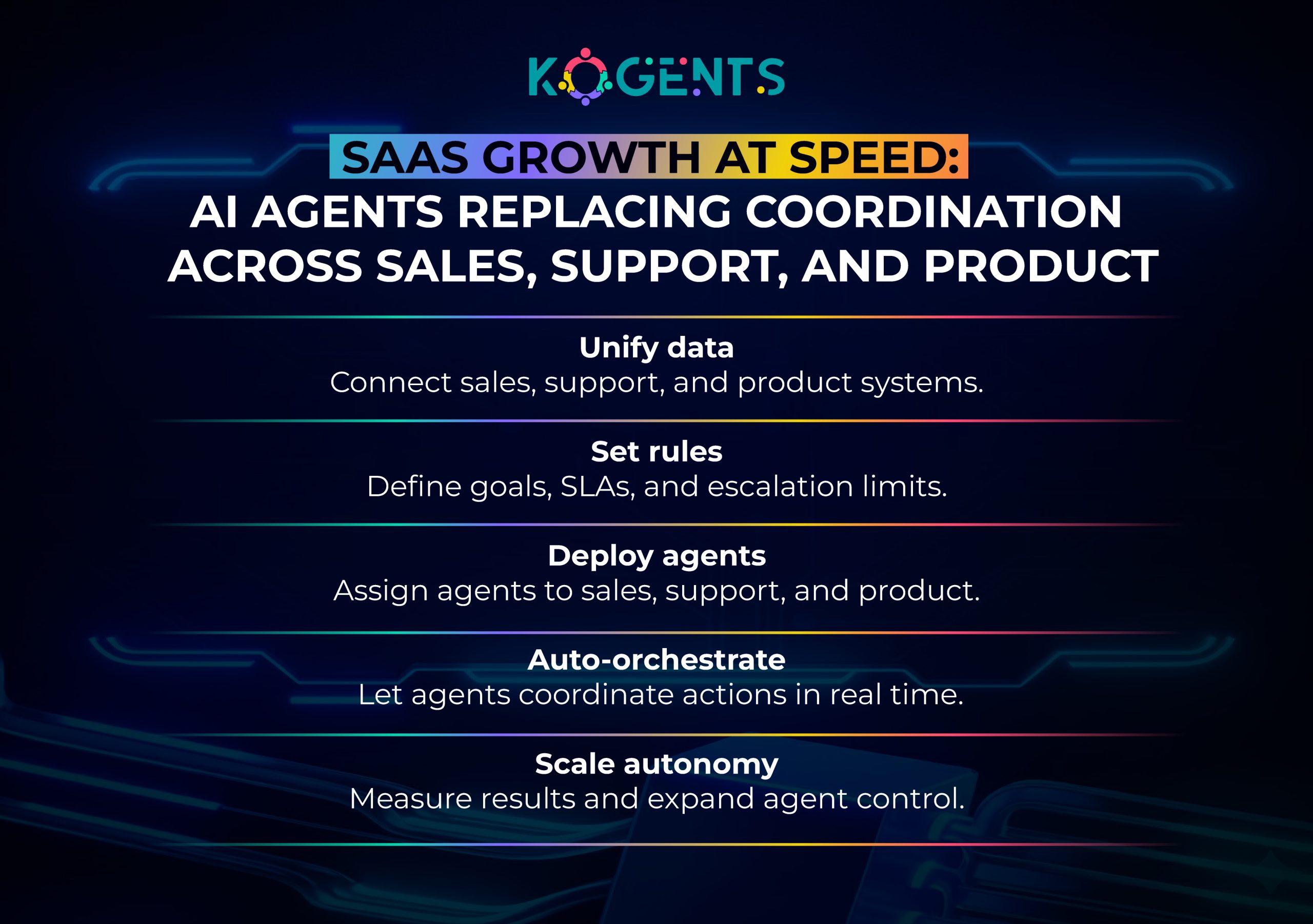
How AI Agents Replace Manual Coordination Step by Step
1. Continuous Event Monitoring
Agents monitor enterprise systems, data streams, and external signals using event-driven workflows.
2. Contextual Understanding
Using large language models, agents interpret intent, urgency, and constraints.
3. Intelligent Task Delegation
Tasks are assigned automatically through AI agents for task delegation and scheduling, based on priority and availability.
4. Cross-System Orchestration
Agents coordinate tools and platforms using AI orchestration agents, eliminating handoffs. 5. Feedback-Driven Optimization
Agents analyze outcomes and improve workflows through workflow optimization loops. This end-to-end autonomy eliminates coordination overhead.
Multi-Agent Systems: The Backbone of Autonomous Enterprises
Single agents manage tasks, while Multi-agent systems manage organizations. In enterprise environments, specialized agents collaborate to:
- Plan work
- Execute actions
- Monitor performance
- Resolve exceptions
Together, they form agent-based systems capable of enterprise automation at scale. Where AI Agents Will Fully Replace Manual Coordination Project and Program Management
AI agents replacing project managers handle timelines, dependencies, risks, and resource allocation continuously.
Operations and Supply Chain
AI agents for enterprise operations coordinate vendors, inventory, logistics, and forecasting without human intervention.
Customer Experience Coordination
Agents route, resolve, and escalate issues in real time, reducing response delays. IT and DevOps
Autonomous systems manage deployments, incidents, and infrastructure health. HR and Internal Operations
Agents manage approvals, scheduling, onboarding, and compliance workflows seamlessly.
Key Comparison Table: Coordination Models
| Dimension | Manual Coordination | AI Agents Replacing Manual Coordination |
| Speed | Delayed, sequential | Real-time, parallel |
| Accuracy | Error-prone | High precision |
| Scalability | Limited by humans | Near-infinite |
| Cost | High and growing | Optimized |
| Availability | Business hours | 24/7 |
Used Cases/ Enterprise Case Studies
Case Study 1: Global Logistics Enterprise
A Fortune 500 logistics organization deployed AI agents for cross-team coordination across procurement, warehousing, and delivery.
Impact:
- 42 percent reduction in delivery delays
- 31 percent operational cost savings
- Near-zero manual coordination
Case Study 2: Financial Services Compliance Automation
A multinational bank replaced human coordination in compliance workflows using AI agents for business process automation.
Impact:
- 55 percent faster regulatory reviews
- 70 percent reduction in audit errors
- Continuous compliance monitoring
Case Study 3: SaaS Enterprise Operations
A high-growth SaaS company implemented AI agents managing workflows autonomously across sales, onboarding, and customer support.
Impact:
- 60 percent faster onboarding
- 28 percent shorter sales cycles
- Fully automated Tier-1 support
The 2030 Enterprise Operating Model
By 2030:
- Coordination becomes AI-native
- Humans focus on strategy and innovation
- Agents execute continuously
- Organizations operate without friction
This future is defined by intelligent automation, scalability, and seamless system integration.
Conclusion: Why Kogents Leads the Agentic AI Future
The future of enterprise execution is autonomous.
AI agents replacing manual coordination are not incremental improvements. They represent a fundamental shift in how work gets done.
Kogents builds autonomous AI agents for operations, AI orchestration agents, and intelligent automation systems designed to eliminate coordination
If your organization is ready to operate faster, smarter, and without friction, Kogents.ai, being your best agentic AI company, can aid in partnering for the 2030 enterprise.
Manual coordination is ending.
Agentic AI is already here.
FAQs
What are AI agents in enterprise automation?
AI agents are autonomous systems that perceive enterprise environments, reason over data, and act independently to execute workflows. Unlike traditional automation, they do not rely on predefined scripts alone. Instead, they adapt dynamically using large language models, enabling them to manage coordination, decisions, and execution across complex systems.
How do AI agents replace manual coordination in practice?
AI agents replace coordination by continuously monitoring events, interpreting context, delegating tasks, and orchestrating workflows in real time. This eliminates the need for meetings, approvals, and follow-ups, allowing AI agents to replace manual coordination to operate faster and more consistently than humans.
What makes AI agents better than human coordinators?
AI agents outperform humans because they operate without fatigue, process vast amounts of data instantly, and coordinate across multiple systems simultaneously. This enables real-time coordination and consistent execution that human teams cannot sustain.
Can AI agents manage complex enterprise workflows?
Yes. AI agents for enterprise operations are specifically designed to handle multi-step, cross-department workflows. Through multi-agent systems, they coordinate planning, execution, monitoring, and exception handling autonomously.
How are AI agents different from RPA tools?
RPA tools execute predefined rules. AI agents reason, adapt, and optimize. While RPA automates tasks, AI agents replacing human coordination automate decisions, ownership, and orchestration.
Are AI agents secure and compliant?
When implemented correctly, AI agents include governance controls, audit trails, and compliance checks. Enterprises often deploy human-in-the-loop oversight initially to ensure safety and regulatory alignment.
Which industries benefit most from AI agents?
Industries with complex workflows, such as finance, logistics, healthcare, SaaS, manufacturing, and retail, see the highest impact from agent-based automation systems.
Will AI agents eliminate jobs?
AI agents eliminate coordination work, not strategic roles. Employees shift from managing workflows to higher-value activities such as innovation and decision making.
How soon will AI agents fully replace manual coordination?
Most analysts predict near-total replacement by 2030, with partial adoption accelerating rapidly over the next 3–5 years.
How can enterprises start deploying AI agents today?
Organizations typically begin by working with AI agent implementation services and gradually expanding agent autonomy across operations.

Kogents AI builds intelligent agents for healthcare, education, and enterprises, delivering secure, scalable solutions that streamline workflows and boost efficiency.